
Screening an address is easy. Explaining why it is risky is the harder problem.
When a regulator or auditor asks why a transaction was approved or blocked, a score alone is not an answer. The evidence behind the decision is.
Most screening tools stop at the label. zScreen starts there.
What is zScreen?
zScreen screens a wallet address and returns a verdict: CLEAR, REVIEW, or FLAGGED. Each verdict comes with the money trail and the evidence behind it.
Coverage runs across 40+ blockchains, including Bitcoin, Ethereum, Tron, Solana, BNB Chain, Polygon, and major EVM networks.
zScreen is built for compliance teams, exchanges, and any operation that needs to understand the wallets it interacts with before funds move.
Three verdicts. The distinction matters.
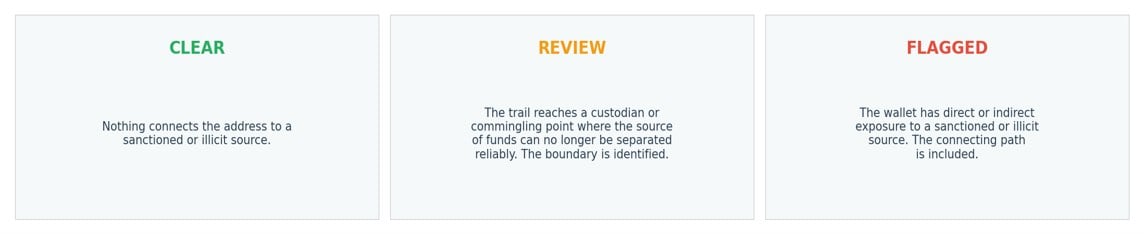
The REVIEW verdict exists because a binary CLEAR / FLAGGED system creates a false choice: flag every wallet that touches a custodian, or ignore custodian exposure entirely.
Neither approach is defensible.
Following the funds
Value can move through chains of intermediaries before reaching its destination. A tool that checks only direct exposure misses the path between the source and the wallet being screened.
zScreen follows value through the transfer graph across multiple hops. Transaction history is pulled around designated addresses, attribution is resolved to the entity behind an address where possible, and commingling boundaries are marked where the movement of individual funds can no longer be separated.
Exposure share is computed twice under independent accounting models and then reconciled.
The result is not simply a connection between two addresses. It is a traceable explanation of how the exposure exists.
Source of funds → Intermediaries → Commingling boundary → Wallet being screened
Four recurring structures
Addresses change. The structures used to move funds often do not.
zScreen looks for recurring patterns across the transaction graph:
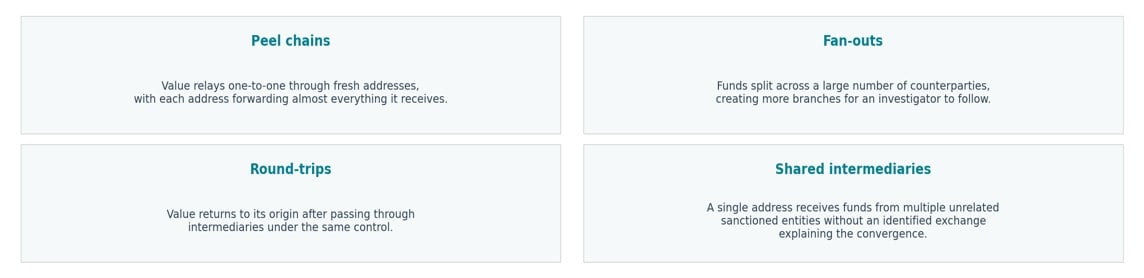
These patterns do not exist as standalone labels. They become part of the evidence used to assess a wallet.
Contract-level attribution
Ticker symbols are not enough.
Thousands of counterfeit contracts impersonate major stablecoins. A tool that matches only on symbols can treat every token labelled USDT as equivalent.
zScreen matches at the contract level. Transfers are verified against known legitimate contracts before attribution is applied.
That matters because risk analysis depends on identifying what actually moved, not what a token claimed to be.
What every alert contains
Every result includes a plain-language explanation of what was found, how the observation affected the risk assessment, and how certain the system is about the finding.
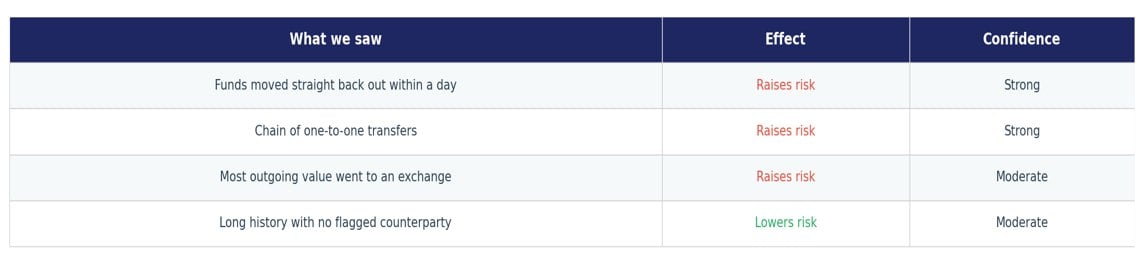
An analyst can act on the result without rebuilding the case. An auditor can replay the decision without reconstructing it from the beginning.
Built at scale

Onchain risk does not stop at one wallet or one chain. Screening infrastructure cannot either.
Compliance alignment
zScreen is built for an environment where screening decisions may need to be reviewed later.
A screening decision should be defensible
A screening decision should be defensible. The goal is to give teams enough information to make a decision before funds move. That means understanding the exposure, transaction path, supporting evidence, and the limits of attribution.
zScreen is built to put that information in front of the team before the decision is made.
Try the tool: zscreen.zeruai.org/app
Book a demo: calendly.com/ajay-zeru/30min
Documentation: zscreen.zeruai.org/docs