

Here's the top of the board.
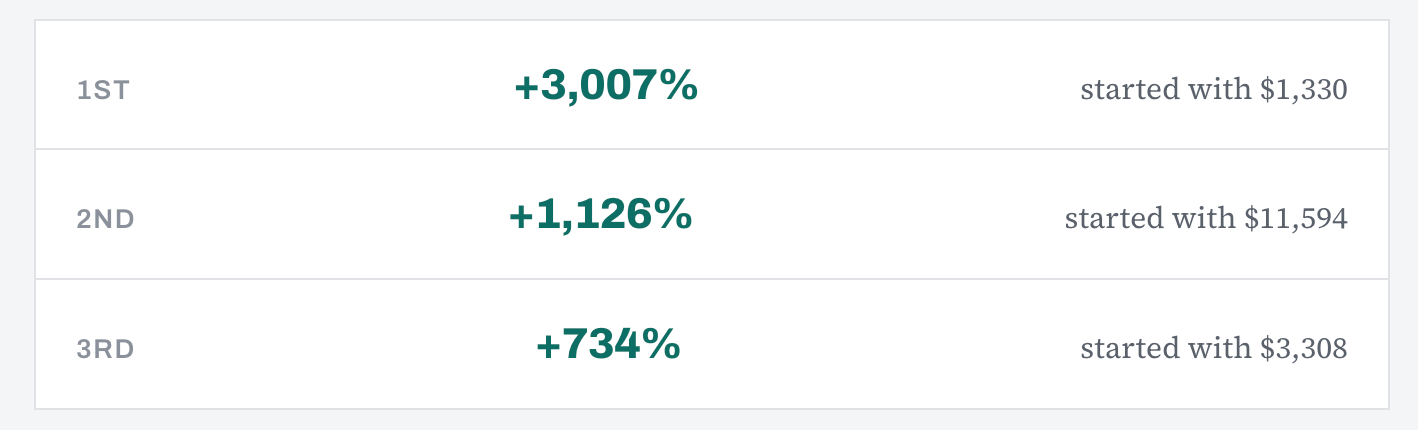
First place turned $1,330 into roughly $41,000. That's a genuinely good trade and I don't want to take it away from him. But look at the third column. The entire podium is running accounts smaller than a used car.
It's not a coincidence, and it's not luck. Across every trader we rate, the typical account holds $101,331. Across the top hundred by percentage return, the typical account holds $18,889. The winners' circle runs on a fifth of a normal account, every single time you compute it.
That's just what division does. Percentage is profit divided by what you had. Make the bottom number small enough and almost any profit turns into a headline number. The board isn't finding the best traders. It's finding the smallest ones.
A kid turns $5 into $10 and doubles his money. A fund makes 12% on $7 million. Percentage says the kid won.
Two real results from the same data. One trader made $929,762 on about $7.5 million. Another made $82,801 on about $142,000.
On pure percentage it's not close — 12% against 58%. The second trader buries the first.
When we let the size of the account count for something, the second trader still wins. He should; 58% is better trading. But he wins by a sensible margin now, and the guy who made nearly a million dollars stops being invisible. Our ratings put them at 877 and 659.
Once you can compare across account sizes, a pattern shows up that a percentage board can never show you. Returns fall as accounts grow. Not sometimes — consistently, all the way up.
Traders working with $1,000 to $10,000 typically made 15.2%. Traders working with over $10 million typically made 6.2%. In that window, 22 wallets doubled their money, and not one of them had a million dollars behind it.
That isn't big traders being worse. It's what happens when you try to move real size — the market moves against you, positions have limits, and getting out takes longer. Making 6% on eight figures is a harder piece of work than making 15% on five. A percentage board will never tell you that.
The moment your starting balance decides your rank, your starting balance becomes the thing worth faking. Put in a large amount, trade for three days, pull it out, and a naive average makes it look like you started with a tenth of what you had.
We passed on the obvious fix. A minimum account size would clean this up, but it deletes a quarter of everyone who trades and paints a bright line for people to stand just above. What we use instead can only ever push a rating down, never up, and it touches about 2% of accounts.
The end result is the shape we wanted. The 53 traders clearing a million in profit sit around 749. The 1,871 working with under ten thousand dollars sit around 537 — and seven of those small accounts still beat the typical million-dollar earner. Small traders can absolutely win. They just have to win, rather than divide by a small number.
Every leaderboard is a quiet statement about what counts. Sort by percentage and you're saying a dollar risked on a thousand-dollar account is worth the same as a dollar risked on ten million.
Nobody believes that once you say it out loud. Plenty of leaderboards say it every day.